
A Repeatable Options Analysis Framework for Every Trade
Options trading rewards discipline. The traders who last aren't the ones who find a clever trade once—they're the ones who evaluate every trade the same way, every time. That's the idea behind a repeatable options analysis framework: a fixed checklist you run before you risk capital, regardless of whether you're buying a single call or building a four-leg iron condor.
Below is a framework you can apply to any options trade, along with where Compounder fits into each step.
Step 1: Pull the Chain and Frame the Trade
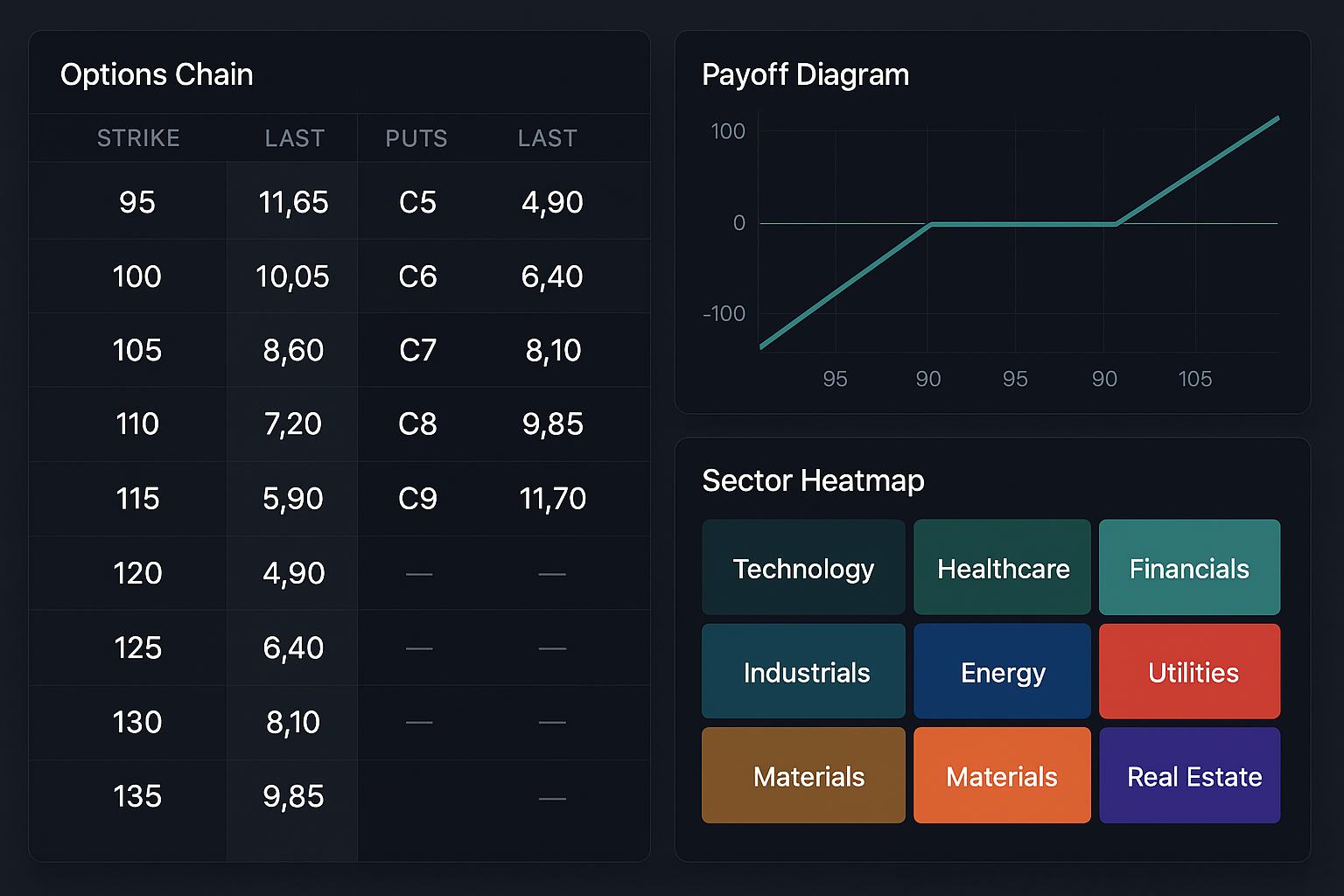
Every analysis starts with the raw data. On Compounder's Options page, enter a ticker and click Load chain to fetch all available contracts for that stock. Once it loads, you'll see:
- The current underlying stock price
- An expiration date selector to move between contract cycles
- A call/put toggle to switch views
- A table of strikes with last price and bid/ask
Before you touch a single Greek, use this view to answer basic questions: What strikes are actually liquid (tight bid/ask)? Which expirations have enough volume to enter and exit cleanly? What's the underlying trading at relative to the strikes you're considering? This is the foundation everything else in your framework builds on—skip it, and every downstream calculation is working off bad inputs.
Step 2: Check the Sector Backdrop
An options trade doesn't happen in a vacuum. A short-dated call on a stock in a sector that's quietly deteriorating is a different risk than the same trade in a sector with strong momentum.
This is where Industry Analysis earns its place in the framework. Open the sector heatmap to see a color-coded view of every sector, ranked by median Compounder Score. Click into the sector your ticker belongs to and you'll get a full roster of stocks ranked by quality score, along with links to the relevant sector ETF for benchmarking. If the stock you're trading options on is a laggard in a weak sector, that's context worth weighing before you commit to a directional bet—even a well-structured one.
Step 3: Map the Greeks to Your Thesis
With chain data and sector context in hand, work through the Greeks as a set of questions, not just numbers:
- Delta — How much directional exposure does this position actually carry? Does it match your conviction level, or is it more aggressive (or timid) than you intended?
- Theta — Are you paying time decay or collecting it? If you're long premium, know exactly how much value erodes per day if the stock sits still.
- Vega — Is the trade a bet on volatility expanding or contracting, separate from price direction? Many traders get this wrong and don't realize it until IV moves against them.
- Gamma — How much will your delta shift as the stock moves? This matters most near expiration or with strikes close to the money.
You can approximate all of this using the strike, last price, and bid/ask data in the options table—the goal isn't precision to the decimal, it's making sure the position's actual risk profile matches what you think you're trading.
Step 4: Calculate Breakeven Points
Every structure—single-leg or multi-leg—has one or more breakeven prices. Using the premiums from the chain, work out:
- Where the underlying needs to be at expiration for the trade to be profitable
- How far that is from the current stock price (in dollars and in percentage terms)
- Whether that move is realistic given the stock's typical trading range
This step alone kills a lot of bad trades. A strategy that only works if the stock moves 15% in three weeks needs a much stronger thesis than one that breaks even on a 2% move.
Step 5: Estimate Probability of Profit
Probability of profit ties delta, time to expiration, and implied volatility together into one practical question: realistically, how often does this trade make money?
A trade with a great payoff if everything goes right but a low probability of getting there is a different bet than one with a smaller payoff and a high hit rate. Neither is automatically wrong—but you should know which one you're making. Compare this probability against your breakeven analysis from Step 4 to sanity-check that the numbers tell a consistent story.
Step 6: Sketch the Payoff Diagram
Before entering any multi-leg trade, map the payoff across a range of prices at expiration:
- Maximum profit and where it occurs
- Maximum loss and where it occurs
- Where the payoff curve flattens or kinks (common with spreads, condors, and butterflies)
Even a rough hand-drawn version of this diagram, using the strikes and prices from your loaded chain, forces you to confront the full range of outcomes—not just the one you're hoping for.
Step 7: Document the Thesis
A framework only compounds in value if you can look back on it. Once you've built out an analysis using Industry Analysis and the options chain, document your reasoning—what the sector backdrop looked like, why the strikes made sense, what the breakevens and probability of profit told you.
If you've run a broader research question through Compounder's AI research tools and received a shared research link, that page preserves the full trace: the question asked, the date and time it ran, and the step-by-step findings. Revisiting that alongside your options analysis later—especially after the trade closes—is how you find the patterns in what actually works for you.
Why Consistency Beats Cleverness
The traders who blow up rarely do so because they lacked a good idea. They do so because they applied rigor inconsistently—thorough on the trades they were excited about, sloppy on the rest. A repeatable options analysis framework removes that variability. Every trade gets the same chain review, the same sector check, the same Greeks and breakeven math, the same probability check, and the same payoff sketch.
It's not glamorous. But it's the difference between trading on conviction and trading on discipline—and over enough trades, discipline wins.