
Free Stock Screener Guide: Find Quality Stocks in Seconds
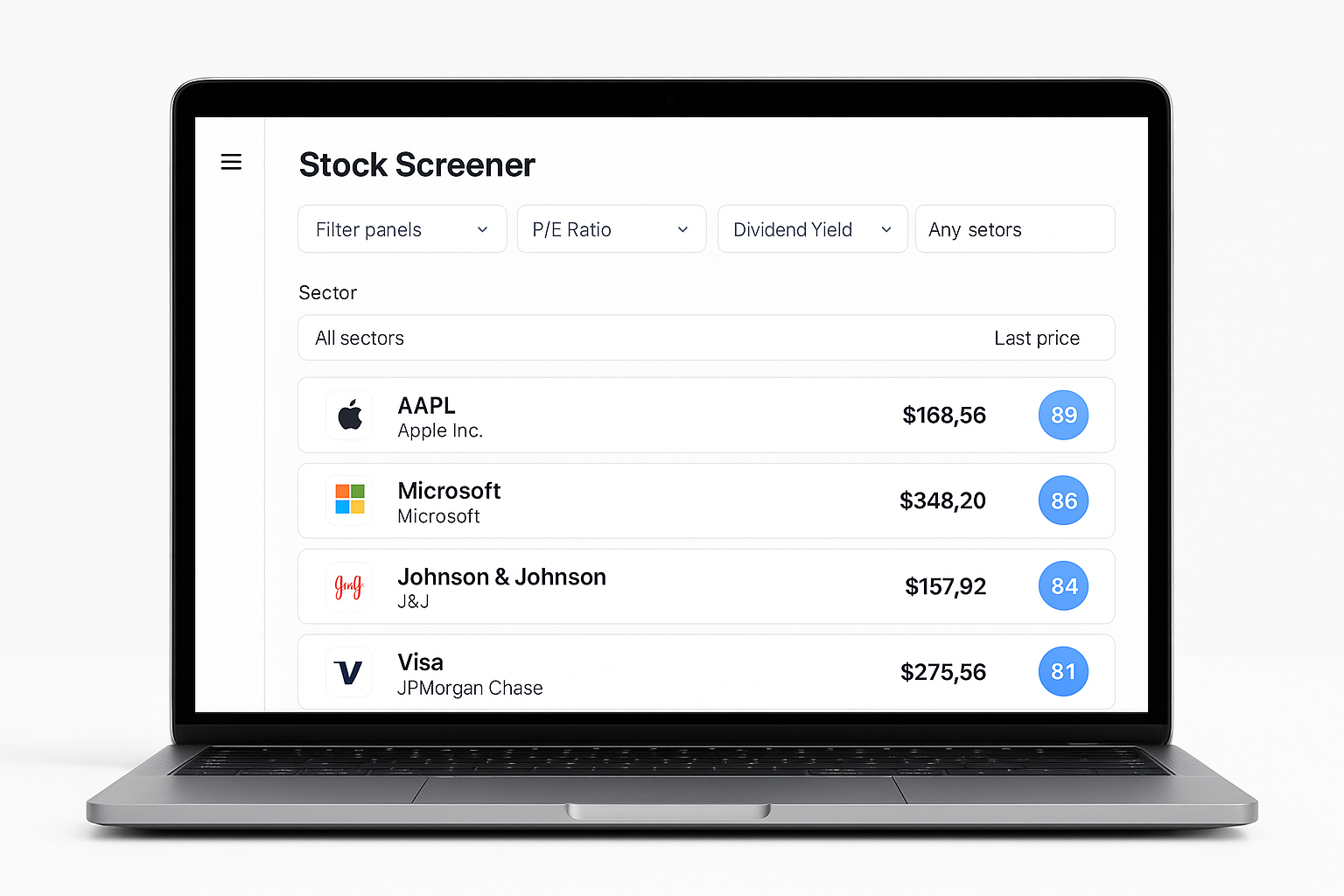
Somewhere between 4,000 and 8,000 publicly traded companies are sitting in the market right now, and you have time to research maybe a dozen of them this week. A stock screener is the tool that closes that gap — it lets you set criteria (profitability, valuation, size, sector) and instantly narrow the universe down to a shortlist worth your attention.
The good news: you don't need a Bloomberg terminal to screen stocks well. A stock screener free of charge can get you most of the way there. This guide walks through what free screeners do well, where they fall short, and how preset, strategy-based screens can save you the step of building filters from scratch.
What a Stock Screener Actually Does
At its core, a screener is a filter. You tell it what you care about — market cap, sector, price-to-earnings ratio, debt levels — and it returns every stock in its database that matches. Instead of scrolling through an index one ticker at a time, you get a working list in seconds.
The value isn't just speed. A good screener forces you to define your criteria upfront, which keeps you from chasing whatever stock is trending on social media that day. You decide what "quality" or "cheap" means to you, and the screener holds you to it.
Free Screeners: What You Get (and What You Don't)
Tools like Finviz have made free stock screening mainstream, and for basic filtering they're genuinely useful. You can typically sort by sector, market cap, price, volume, and a handful of valuation ratios like P/E or P/B.
Where free screeners tend to run out of road is depth. Raw ratios tell you a stock is "cheap" or "profitable" in isolation, but they don't tell you why, or how a company scores across the multiple dimensions that actual investing strategies use — profitability, balance sheet strength, capital efficiency, and valuation all considered together. That combination is what separates a screener that gives you a list from one that gives you a shortlist you can actually trust.
Screening with Named Strategies, Not Just Ratios
Decades of public market research have produced well-known screening philosophies — quality-focused approaches in the spirit of Warren Buffett, deep-value approaches like Benjamin Graham's net-net method, and systematic rules-based models that rank stocks on combined profitability and value factors. The appeal of these frameworks is that they've been stress-tested conceptually for years; you're not inventing your own rulebook from scratch.
The catch is that most free screeners make you rebuild these frameworks manually, ratio by ratio, and hope you got the formula right. Compounder takes a different approach by scoring companies against these frameworks directly, so instead of assembling filters yourself, you can lean on structured strategy types that are already defined:
- Buffett quality scoring (70+): ranks companies on a quality score meant to reflect durable, well-run businesses — the kind of profile long-term, quality-focused investors look for.
- Graham net-net undervalued: surfaces companies trading at a deep discount to their net asset value, echoing the classic deep-value screening approach.
- Compounder Score top N%: ranks the covered universe by Compounder's proprietary scoring system and lets you isolate just the top slice.
These aren't just labels — they're strategy types you can actually test, which matters more than most screeners let on.
Backtest the Strategy Before You Trust It
A screener tells you what a strategy would have surfaced today. A backtest tells you whether that strategy would have actually worked over time. Compounder's Backtest tool lets you configure and run historical tests of exactly these stock-selection strategies.
Setting one up takes a few inputs:
- A memorable name for your test
- The strategy type — Compounder Score top N%, Buffett quality scoring 70+, or Graham net-net undervalued
- A historical date range (minimum 90 days)
- A rebalance frequency — Monthly, Quarterly, or Yearly
- The percentage of the universe to include
This matters because "quality" and "value" screens can look great on paper but behave very differently depending on rebalance cadence and market conditions. Backtesting turns a static filter into a strategy you can actually evaluate before committing real capital to it.
Browsing the Full Stock Universe
Sometimes you don't want a strategy — you just want to explore. The Browse Stocks page displays every company in Compounder's covered universe (any company with ingested financial data), and a filter card at the top gives you fast, familiar controls:
- Search by ticker symbol, company name, or partial match, with results updating as you type
- Sector dropdown to narrow by industry, or leave it on All sectors
- Market cap dropdown — Any size, Mega cap (>$200B), Large cap ($10B–$200B), Mid cap ($2B–$10B), and smaller tiers below that
This is the layer that plays the same role a stock screener free tool like Finviz plays — quick, broad filtering — but it sits right next to the strategy-scored tools, so you can move from browsing to backtesting without switching platforms.
Building a Watchlist as You Go
Screening is only useful if you actually track what you find. Compounder makes this frictionless with Quick Follow: anywhere you see a + Follow button — on a stock card, sector card, or theme card — clicking it immediately adds that item to your Following list. You don't need to navigate to the Following page first; you can build a watchlist in real time as results come up in your screen or browse session.
Choosing the Right Screener for You
If you just need to sort by sector and market cap, a free stock screener like Finviz will get the job done, and there's no reason to overcomplicate it. But if you want your filters to reflect an actual investing framework — and you want to know whether that framework has historically held up — that's where quality-scored presets and a real backtester earn their keep.
The fastest path from "thousands of stocks" to "a shortlist I trust" isn't more filters. It's better-defined ones.