
How to Find Quality Dividend Stocks Beyond the Yield Chase
A 9% yield looks like a gift. Often, it's a warning label. When a stock's dividend yield spikes, it's usually because the price has fallen—and the market is pricing in a cut that hasn't happened yet. Chasing that number without checking the business behind it is one of the most common ways income investors lose money.
Finding quality dividend stocks isn't about hunting for the highest payout. It's about identifying companies that can keep paying, and growing, that dividend for years without straining their finances. Here's how to build that filter for yourself.
The Yield Trap: Why High Dividend Stocks Can Be a Warning Sign
Yield is a ratio: annual dividend divided by share price. That means yield can rise for two very different reasons—the company raised its dividend (good), or the stock price collapsed (bad). A falling stock price often reflects deteriorating fundamentals: shrinking margins, rising debt, or a business model losing ground to competitors.
When investors screen only for yield, they end up overweighting exactly the companies most likely to cut. A dividend cut doesn't just cost you income—it usually triggers a further price decline as yield-focused holders sell. The goal isn't to avoid yield entirely. It's to pair yield with evidence that the company can actually afford it.
What "Quality" Actually Means for Dividend Investors
Quality dividend investing borrows a page from the Dividend Aristocrats playbook—companies with long histories of raising payouts—but adds a layer of financial scrutiny so you're not just trusting a streak. A few metrics matter more than the yield itself.
Free Cash Flow Margin Streaks
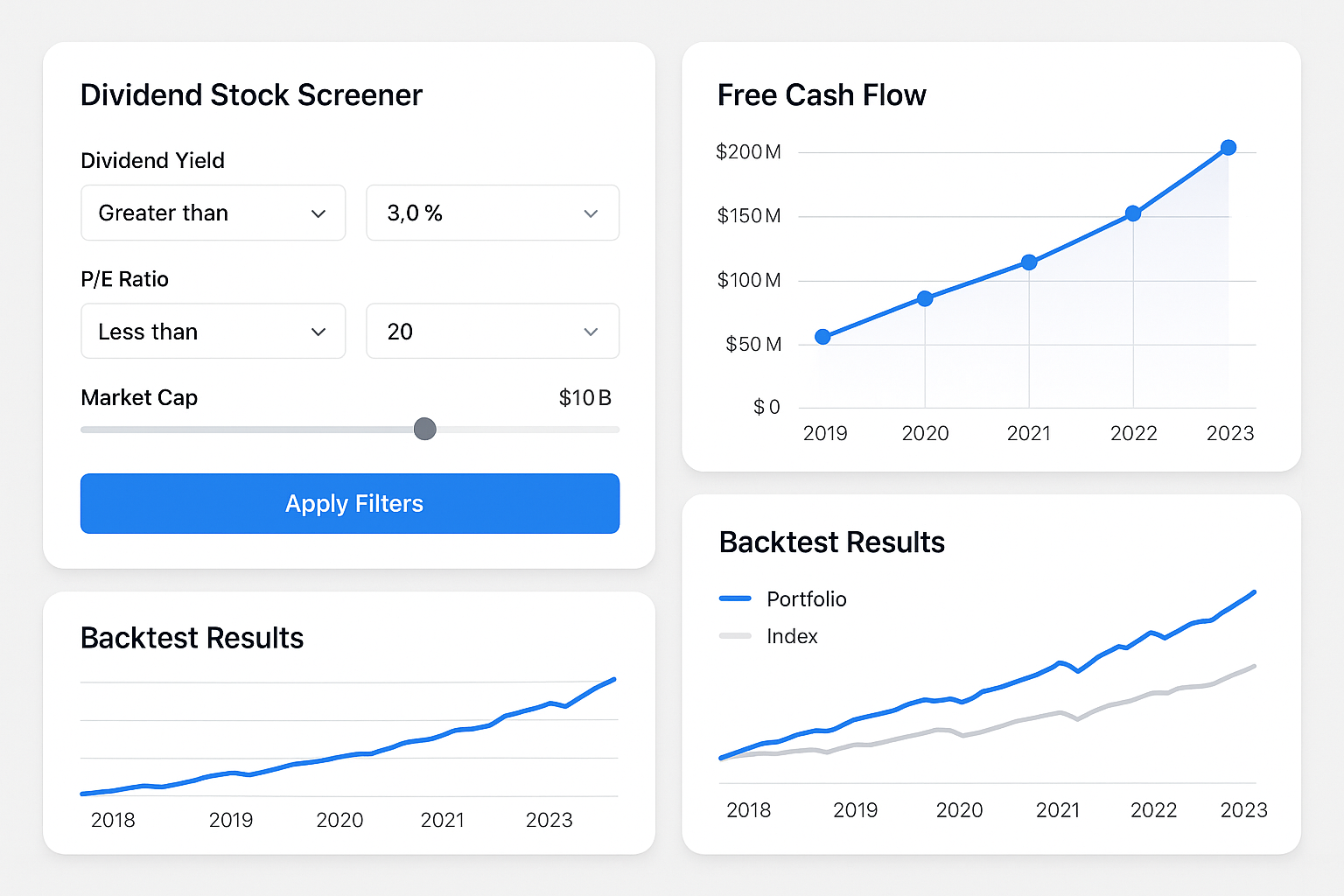
Dividends are paid in cash, not earnings, so free cash flow (FCF) is the real source of truth. A company with a consistent, ideally expanding, FCF margin over multiple years has the operating engine to support—and grow—its dividend without borrowing to do it. A single strong year means little. A multi-year streak of healthy FCF margins is what separates a durable payer from a fragile one.
Payout Ratio Discipline
How much of that free cash flow is actually going out the door as dividends? A company paying out a small, stable share of its cash flow has room to weather a bad quarter. One paying out nearly all of it—or more—has no cushion, and any hiccup in earnings puts the dividend at risk.
Consistency Over Time
Aristocrat-style screens look for years of consecutive dividend increases, and that history is genuinely useful—it filters out serial cutters immediately. But consistency of the dividend should be checked against consistency of the underlying business. A long increase streak paired with a shrinking FCF margin is a company living on borrowed time.
Building Your Own Quality Dividend Screen
You don't need a terminal on your desk to build this kind of screen—you need the right filters and the discipline to use them together, not in isolation.
Start with Browse Stocks
Compounder's Browse Stocks page shows every company in the covered universe—every business with ingested financial data—and lets you narrow the list fast. Use the Sector dropdown to focus on areas known for dividend consistency, like consumer staples or utilities, and the Market cap filter (Mega cap over $200B, Large cap $10B–$200B, Mid cap $2B and up) to decide whether you want established payers or mid-cap names still building their streaks. If you already have a candidate in mind, the search box finds it instantly by ticker, name, or partial match.
Layer in Quality Scoring
Once you've narrowed the universe by sector and size, the next step is separating the durable payers from the pretenders. This is where a quality-first mindset—checking FCF margin trends and payout discipline rather than yield alone—turns a broad list into a genuine shortlist. Think of the sector and market cap filters as your first pass, and quality checks on cash flow and payout ratio as the second, more important pass.
Backtesting Your Dividend Strategy Before You Commit
A screen is only a hypothesis until you've tested it against history. Compounder's Backtest tool lets you configure and run historical tests of a stock-selection strategy before you put real money behind it.
In the Backtest form, you can:
- Give your test a memorable name so you can compare strategies later
- Choose a strategy type—Compounder Score top N%, Buffett quality scoring 70+, or Graham net-net undervalued
- Set a historical date range (minimum 90 days)
- Pick a rebalance frequency: Monthly, Quarterly, or Yearly
- Define what percentage of the universe to include
For quality-focused dividend investing, the Buffett quality scoring 70+ strategy type is particularly relevant—it's built around the kind of durable, cash-generative businesses that can actually sustain a rising dividend, rather than simply screening for the highest payout ratio on the market. Running this against a multi-year window shows you how a quality-first approach would have actually performed, rebalanced on the schedule you choose, instead of relying on backward-looking assumptions about which companies "felt" safe.
Track Candidates Without Losing Them
As you move through sector screens, quality checks, and backtests, you'll accumulate a list of names worth watching. You don't need to jump to a separate Following page to save them. Anywhere you see a + Follow button—on a stock card, sector card, or theme card—click it and that item is immediately added to your Following list. It's a small feature, but it means you can follow a candidate the moment it passes your quality bar, without breaking your research flow to go manage a watchlist separately.
Putting It All Together
Quality dividend investing is really a two-step discipline: first, narrow the universe by sector and size to the areas where durable payers tend to live; second, confirm that durability with FCF margin trends, payout discipline, and a track record that holds up under a strategy backtest—not just a headline yield. Do both, and you'll spend a lot less time worrying about the next dividend cut headline.