
Modern Value Investing: Data-Driven Rules for Today's Market
Value investing has survived market crashes, rate cycles, and decades of people declaring it obsolete. The core idea—buy businesses for less than they're worth and demand a margin of safety—hasn't changed since Benjamin Graham wrote it down. What has changed is how much data an individual investor can get their hands on, and how fast they can act on it.
The problem isn't that value investing stopped working. It's that most retail investors are still running a 1970s strategy with 1970s tools: a stock screener, a calculator, and a lot of manual checking. Institutional desks have moved on to systematic, rules-based processes that flag opportunities the moment they appear. This post is about closing that gap.
What Value Investing Still Gets Right
Graham's two big ideas hold up remarkably well:
- Margin of safety — buy at a discount steep enough to absorb bad news, estimation errors, or plain bad luck.
- Net-net investing — in its purest form, buying companies trading below their net current asset value, so you're effectively getting the business for less than its liquid assets minus all liabilities.
Both ideas are really about the same thing: protecting yourself from being wrong. Modern value investing doesn't throw this out. It just adds better ways to find the setups and confirm them before you commit capital.
Why Value Investing Needs a Data Upgrade
The classic value playbook assumed information was scarce and slow-moving. Today it's the opposite problem — filings, insider trades, price action, and news all update constantly, and most of it is noise. The investors who still do well with value strategies aren't the ones reading more; they're the ones filtering better.
That means turning qualitative rules ("buy cheap, quality businesses with insider confidence") into something you can monitor systematically instead of checking by hand every week.
Turning Value Criteria Into Alert Rules
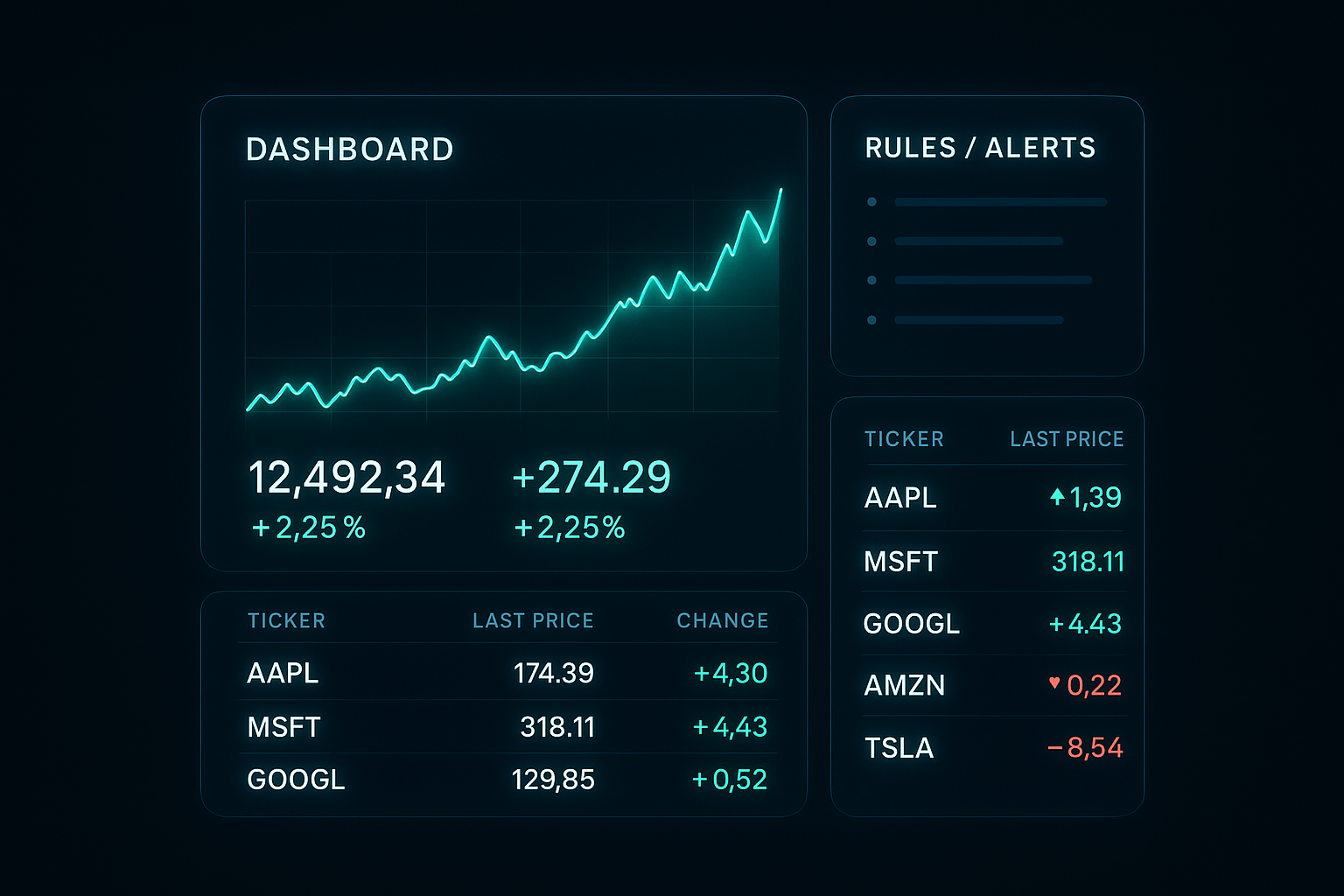
This is where Compounder's Rules tab earns its keep. Instead of manually rescreening the market every few days, you can create alert rules that watch the market for you and only surface a name when your actual value criteria are met.
Here's how that looks in practice:
- Create a rule by picking an alert type and setting the parameters that match your value thesis — for example, a valuation threshold combined with a signal you consider confirmatory.
- Enable or disable rules with the Active checkbox whenever you want to pause a strategy without losing its configuration. Markets get expensive; you don't have to delete your process, just switch it off until conditions change.
- Turn on email delivery with the Email checkbox so matching alerts land in your inbox instead of requiring you to log in and check.
The advantage over a static screener is simple: a screener gives you a snapshot. A rule gives you a tripwire. Once it's configured, it keeps working in the background, and you only get pulled in when something actually matches your criteria — which is exactly how a disciplined value process should run.
Insider Buying as a Modern Margin-of-Safety Check
Graham built his margin of safety around balance sheets. Today, you have another layer of confirmation available: what the people running the company are actually doing with their own money.
The Signals page tracks this directly through Insider Cluster Buys & Sells — cards showing stocks where three or more company insiders (executives, directors) have traded in the last 30 days. Each card gives you the number of insiders involved, total shares, dollar value, and the date range of the activity.
Why this matters for value investing specifically: a cheap stock is only a good value if the underlying business is actually sound, and insiders often have a much better read on that than a P/E ratio does. A cluster of insider buys on a stock that's already screening cheap on fundamentals is a meaningfully different setup than a cheap stock with no insider conviction — or worse, a cluster of insider selling. Buys are the high-conviction signal here; sells warrant more scrutiny before you treat a low valuation as a bargain.
Using insider cluster activity as a secondary filter on top of your valuation screen is a very Graham-compatible upgrade: it's not predicting the future, it's gathering more evidence about the present.
Don't Wall Off Value Thinking From New Asset Classes
Value investing principles didn't originate with crypto in mind, but the underlying discipline — knowing what you own, tracking price action, avoiding decisions based on vibes — applies anywhere you're putting capital at risk.
For investors who keep a toe in digital assets alongside equities, Compounder's Crypto section (available on the Pro plan) gives you a curated table of tokens with symbol, full name, current USD price, and 24-hour percentage change, with gains in green and losses in red. Clicking any symbol pulls up more detail on that asset. It's not a replacement for equity research, but it means you're not tracking your stock watchlist in one tool and your crypto positions in a spreadsheet somewhere else — everything lives in one place, under the same discipline.
Putting It Together: A Modern Value Workflow
A data-driven value process doesn't need to be complicated. It needs to be repeatable:
- Define your valuation criteria — the modern equivalent of Graham's net-net or margin-of-safety math.
- Encode it as an alert rule so you're not manually rescreening the market every week.
- Layer in insider cluster signals from the Signals page as a confirmation check before you commit capital.
- Keep every asset class you actually hold — equities, crypto, whatever else — visible in one workflow instead of scattered across tabs.
- Toggle rules on and off as market conditions shift, rather than abandoning your process entirely when things get quiet.
Value investing was never really about being contrarian for its own sake. It was about discipline: buying with a margin for error and letting the numbers do the talking. The tools have changed. The discipline hasn't — and shouldn't.