
Options Analysis Tools: How to Build a Multi-Leg Strategy Without a Bloomberg Terminal
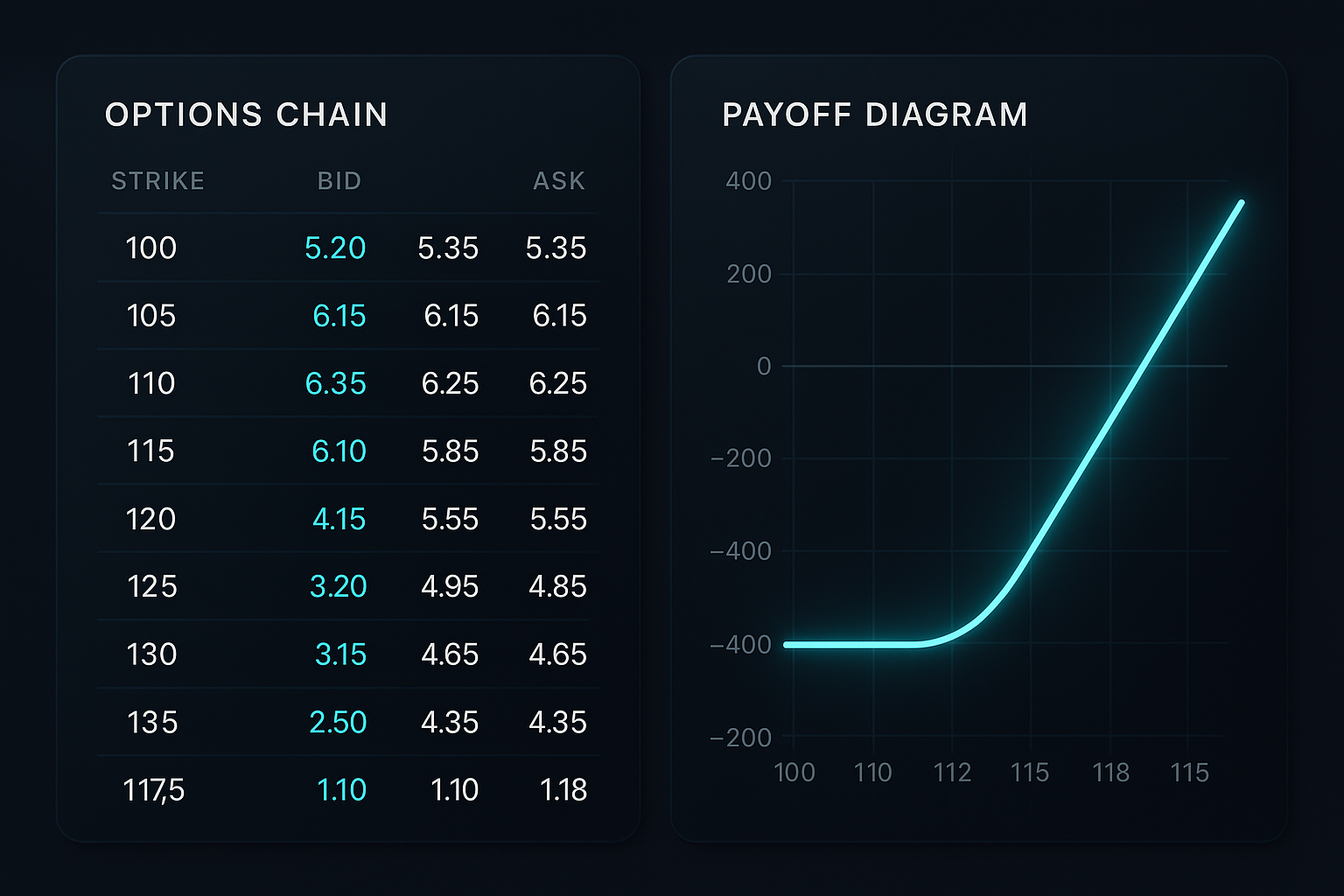
Multi-leg options strategies look intimidating until you break them into parts. A spread, a straddle, an iron condor — each is just a handful of single option contracts combined to shape risk and reward the way you want. The hard part isn't the concept. It's having a clean way to see strikes, prices, and expirations side by side so you can actually build the thing.
That's what a good options analysis tool is for. Below, we'll walk through the core concepts you need to evaluate any options trade, then show how to put them into practice using Compounder's Options Strategy Builder.
The Three Things Every Options Trade Needs
Before you combine contracts into a strategy, you need to understand three building blocks. Skip any one of these and you're trading blind.
1. The Greeks
The Greeks describe how an option's price reacts to changes in the world around it:
- Delta – how much the option's price moves for a $1 move in the stock
- Gamma – how much delta itself will change as the stock moves
- Theta – how much value the option loses each day as it approaches expiration
- Vega – how sensitive the option is to changes in implied volatility
You don't need to memorize formulas. You need to know, directionally, what you're exposed to. A long call has positive delta and negative theta — it wants the stock to go up, and it's bleeding value every day it doesn't. A calendar spread is closer to delta-neutral but very sensitive to vega. Once you're combining multiple legs, the Greeks of each leg net together into a position-level exposure, which is the real risk profile of your trade.
2. The Payoff Diagram
A payoff diagram plots your profit or loss at expiration across a range of stock prices. It's the fastest way to see the shape of a strategy — where it makes money, where it loses money, and how much of each. A single long call has an upward-sloping payoff line with limited downside. A vertical spread caps both the upside and the downside. An iron condor looks like a plateau — flat profit in the middle, losses on both tails.
Sketching this out, even roughly on paper, forces you to confirm the strategy actually does what you think it does before you risk real capital.
3. Breakeven Points
Breakeven is the stock price at expiration where your trade neither makes nor loses money. Every multi-leg strategy has at least one; some, like iron condors, have two. Knowing your breakeven(s) tells you exactly how much room the underlying stock has to move before your thesis is wrong.
Vet the Underlying Before You Build the Trade
A well-constructed spread on a weak company is still a weak trade. Before opening the Options page, it's worth doing a little groundwork:
- Check sector strength. Compounder's Industry Analysis heatmap shows a color-coded view of every sector by median Compounder Score, so you can quickly see whether you're trading into a strong industry or a weak one.
- Score the company. Drill into a sector to see the full ranked roster of stocks by quality score, and compare against the relevant sector ETF benchmark.
- Confirm the strategy has worked historically. If your options view is built on a stock-selection thesis — say, buying calls on high-quality names — the Backtest tool lets you configure a historical test of that selection logic (Compounder Score top N%, Buffett quality 70+, or Graham net-net) across a custom date range and rebalance frequency, so you're not guessing whether the underlying logic holds up.
Once you're confident in the underlying, it's time to build the options position itself.
Building a Multi-Leg Strategy with Compounder's Options Page
Step 1: Load the Chain
Navigate to the Options page and enter a ticker symbol. Click Load chain to pull in the available option contracts for that stock. You'll immediately see the underlying stock price at the top, which is your reference point for every strike you consider.
Step 2: Pick Your Expiration
Use the expiration date selector to move between available contract dates. Different expirations change your theta exposure and how much time your thesis has to play out — a shorter-dated spread decays faster but costs less; a longer-dated one gives the stock more room to move.
Step 3: Toggle Between Calls and Puts
Use the call/put toggle to switch views. Most multi-leg strategies mix or layer calls and puts (or use two of the same type at different strikes), so you'll likely flip back and forth as you sketch out your legs.
Step 4: Read the Table
For each contract, the options table shows the strike price and the last price, along with the bid/ask, so you can see both where the contract last traded and where you could realistically enter or exit right now. This is the data you need to price out each leg of your strategy.
Step 5: Select Your Legs
With the chain in front of you, choose the strikes that build your intended shape:
- Vertical spread: buy one strike, sell another in the same expiration and same option type, to cap both risk and reward.
- Straddle/strangle: buy a call and a put at the same (straddle) or different (strangle) strikes to position for a big move in either direction.
- Iron condor: combine a call spread and a put spread to profit from the stock staying in a range.
Because the chain shows strike, last price, and bid/ask together, you can price each leg individually and add them up to see your net debit or credit — the starting point for both your payoff diagram and your breakeven calculation.
Step 6: Calculate Breakeven and Check the Shape
Once you know your net cost (or credit) and your strikes, you can calculate breakeven points and sketch the payoff diagram by hand or in a spreadsheet. Confirm the shape matches your intent — capped risk, capped reward, or open-ended in one direction — before placing the trade.
Bringing It Together
A multi-leg options strategy is really just several single-leg decisions made at once. The work is in vetting the underlying, reading the chain carefully across strikes and expirations, and doing the arithmetic on breakeven and payoff before you commit capital. Compounder's Options page gives you the live chain data — strikes, prices, expirations, calls and puts — so you can do that work with real numbers instead of guesswork, no Bloomberg terminal required.