
Portfolio Tracker vs. Spreadsheet: What You're Actually Missing
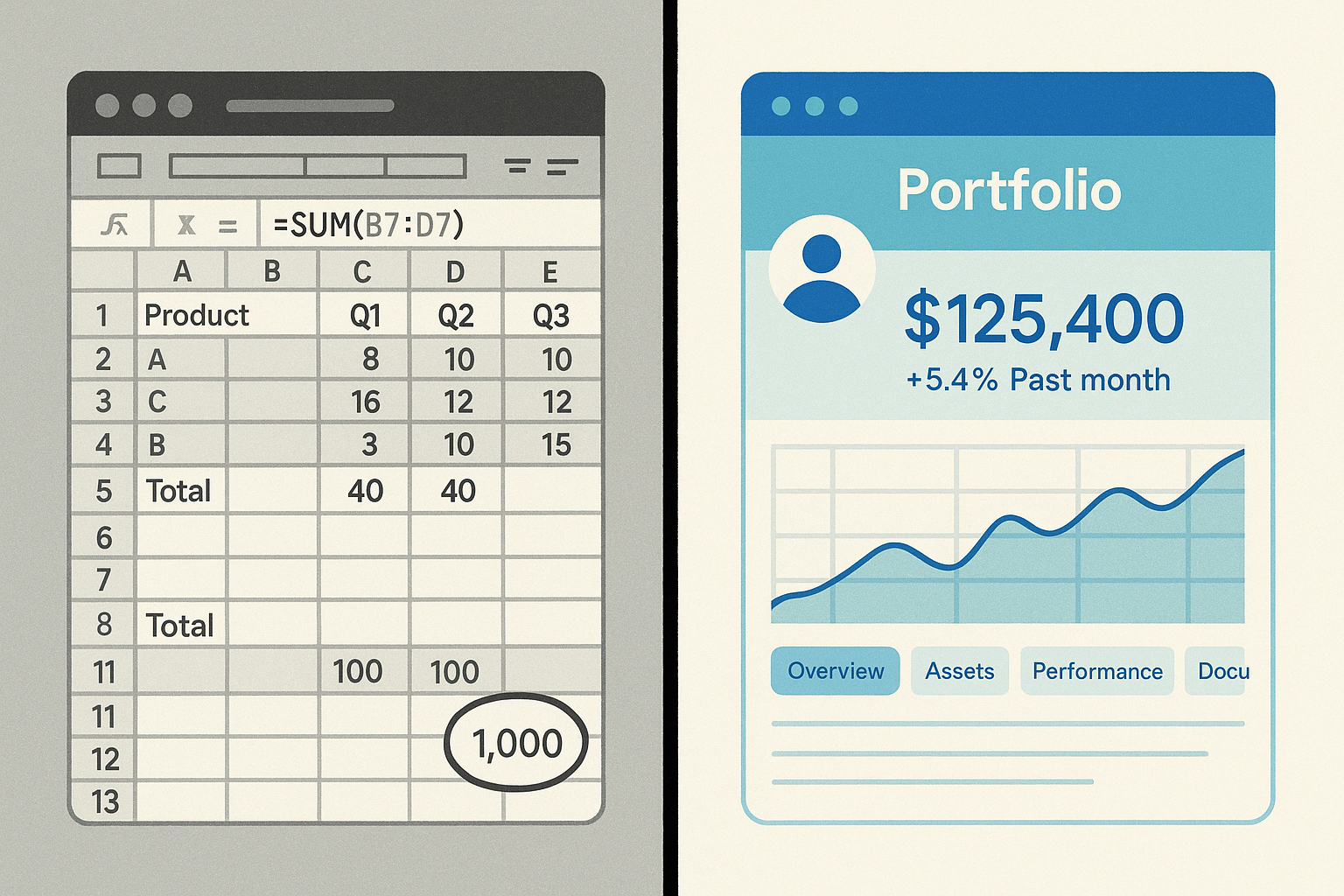
Every investor starts somewhere, and for most of us, that somewhere is a spreadsheet. A column for ticker, a column for shares, a column for cost basis, maybe a VLOOKUP formula you're quietly proud of. It works. Until it doesn't.
The spreadsheet doesn't fail all at once. It fails a little at a time — a stale price here, a manual entry error there, a missing asset class you didn't think to build a column for. By the time you notice, you've been making decisions on bad data for weeks.
Here's a closer look at where manual tracking quietly breaks down, and what a dedicated portfolio tracker is built to handle instead.
The Problem With "It Works For Now"
Spreadsheets are flexible, which is exactly why they're fragile. There's no built-in check that your price feed is current, no alert when a formula reference shifts after you insert a row, and no structure enforcing consistency as your holdings multiply across brokerages, account types, and asset classes.
A few positions in a single account is manageable. Multiple accounts, multiple currencies, stocks alongside crypto, and a growing list of tickers you're trying to keep current — that's where the manual approach starts costing you real time, and real accuracy.
Where Manual Tracking Falls Apart First
Stale or missing prices. Spreadsheets don't refresh themselves. Unless you're manually pulling quotes or maintaining an API connection, your "current value" column is really your "value as of whenever I last updated this" column.
No native support for newer asset classes. Tracking crypto in a spreadsheet usually means a separate tab, a separate price source, and a separate set of formulas — doubling the maintenance work for every token you hold.
No sense of what other capital is doing. A spreadsheet shows you your positions. It doesn't show you how experienced, large-scale investors are positioned right now, which makes it hard to sanity-check your own allocation against anything other than gut feel.
Everything is manual, so everything is a chore. Adding a new position means finding the current price, typing it in, and hoping you didn't fat-finger a decimal. That friction adds up, and it's often the reason portfolios in spreadsheets go stale in the first place — updating them just isn't easy enough to do consistently.
What a Dedicated Portfolio Tracker Adds
Live Crypto Prices, In Context With Everything Else
Compounder's Crypto section shows a curated table of tokens with symbol, full name, current USD price, and 24-hour percentage change — gains in green, losses in red, at a glance. Click any symbol to open a detailed page for that token. No separate spreadsheet tab, no manually refreshed price column, no second data source to maintain.
From that same Crypto Detail Page, adding the position to your portfolio takes a few clicks: hit "Add to portfolio," choose which portfolio it belongs to if you're tracking more than one, enter how much you own and what you paid per token, and save. Your crypto sits alongside your equities instead of living in an entirely separate system that never quite talks to the rest of your portfolio.
(This part of the toolkit is available on the Pro plan — free accounts see an upgrade prompt when they try to access it.)
A Benchmark That Isn't Just "the S&P"
Comparing your returns to a broad index tells you something. Comparing your actual holdings to how a specific, proven investor is positioned tells you a lot more.
Compounder's Legend Portfolio pages give you exactly that: a full snapshot of a well-known investor's holdings, pulled straight from their most recent quarterly SEC 13F filing. You get the investor's name, the filing date, and a dropdown to move between available quarters so you can see how their positioning has shifted over time. Summary statistics sit right at the top — total positions held, total portfolio value, and a breakdown of activity, including new buys, increased stakes, and reduced or exited positions.
A spreadsheet can't produce this. You'd need to track down 13F filings manually, parse them yourself, and rebuild the summary stats from scratch every quarter — for every investor you wanted to follow. Here, it's already assembled and updated on a filing cycle you can browse in seconds.
Used alongside your own holdings, Legend Portfolios function as a kind of model portfolio: not a recommendation to copy trades, but a real, disclosed reference point for how conviction, concentration, and turnover look in practice at the institutional level.
When the Gap Really Shows
The smaller your portfolio, the less any of this matters. Five stocks in one account, updated once a month, is fine in a spreadsheet.
The gap widens as you add:
- More positions across more accounts
- A second asset class, like crypto, with its own price feed and volatility
- A habit of checking in more than once a month
- Any interest in how your allocation compares to investors who manage far more capital than you do
At that point, the spreadsheet isn't saving you effort anymore — it's creating it. Every new position is another manual entry. Every price check is another tab open in your browser. Every comparison to a legendary investor's positioning is a research project instead of a few clicks.
The Real Difference Is Context
A spreadsheet tells you what you own. A portfolio tracker tells you what you own, what it's worth right now, and how that stacks up against something bigger than your own account — whether that's a live crypto price feed or a quarter-by-quarter look at how a well-known investor is actually positioned.
That context is the part manual tracking can't replicate, no matter how good your formulas are. It's not about replacing your judgment — it's about making sure your judgment is working from current, complete information instead of a spreadsheet that's a few days, or a few asset classes, behind reality.