
Quality Investing 101: The Five Metrics That Actually Matter
Every investor says they want to own "quality" companies. Far fewer can define what that actually means. Is it a high return on equity? A clean balance sheet? Consistent earnings? The honest answer is: all of the above, and the trick is knowing how to weigh them.
Quality investing isn't a single number — it's a framework. Below are the five metrics that separate durable businesses from fragile ones, and how they come together into a composite score you can actually use to rank stocks.
What "Quality" Really Means
At its core, quality investing is about buying businesses that can compound value reliably over time, without relying on aggressive assumptions, leverage, or a rising market to bail them out. A quality company tends to:
- Generate real profits, not just revenue growth
- Fund itself without excessive debt
- Produce cash, not just accounting earnings
- Keep improving (or at least not deteriorating) year over year
- Survive downturns instead of needing a bailout to make it through
Each of those ideas maps to a specific, measurable metric. Here they are.
The Five Metrics That Matter
1. Profitability
This is the foundation. Metrics like return on equity (ROE), return on invested capital (ROIC), and operating margin tell you whether a company actually earns attractive returns on the capital it deploys — or whether it's just generating top-line growth without turning it into profit. A business with structurally high margins usually has some kind of durable edge: pricing power, brand strength, or a cost advantage competitors can't easily replicate.
2. Capital Structure
How a company is financed matters as much as how much it earns. A business loaded with debt can look profitable in good times and collapse in bad ones. Quality investors look at leverage ratios, interest coverage, and the mix of debt versus equity funding. A conservative capital structure gives a company room to survive a bad year, invest through a downturn, or ride out a rate shock without existential risk.
3. Earnings Quality
Not all earnings are created equal. Earnings quality asks whether reported profits are backed by real cash flow, or whether they're propped up by accounting choices, one-time gains, or aggressive assumptions. Consistency matters too — a company that grows earnings steadily is generally more trustworthy than one with erratic, lumpy results, even if the average looks similar.
4. Cash Generation
Profit is an opinion; cash is a fact. Free cash flow tells you how much money a business actually generates after covering the capital expenditures needed to keep operating. Strong, consistent free cash flow gives a company options: paying down debt, returning capital to shareholders, reinvesting in growth, or simply surviving a rough patch without raising money on unfavorable terms.
5. Trend — Are Fundamentals Improving?
A snapshot only tells half the story. The direction of travel matters just as much as the current level. Is margin expanding or shrinking? Is debt rising or falling? Is the company becoming more efficient with its assets over time? A mediocre company improving steadily can be a better opportunity than a great company quietly deteriorating.
Why One Score Isn't Enough
Here's the challenge: these five dimensions don't always point the same direction. A company can be highly profitable but drowning in debt. Another can have a pristine balance sheet but declining margins. Judging quality on a single metric in isolation is how investors get blindsided — they see one green flag and miss three red ones sitting right next to it.
That's why quality investing works best as a composite view, not a checklist you eyeball one line at a time.
How Compounder Brings This Together
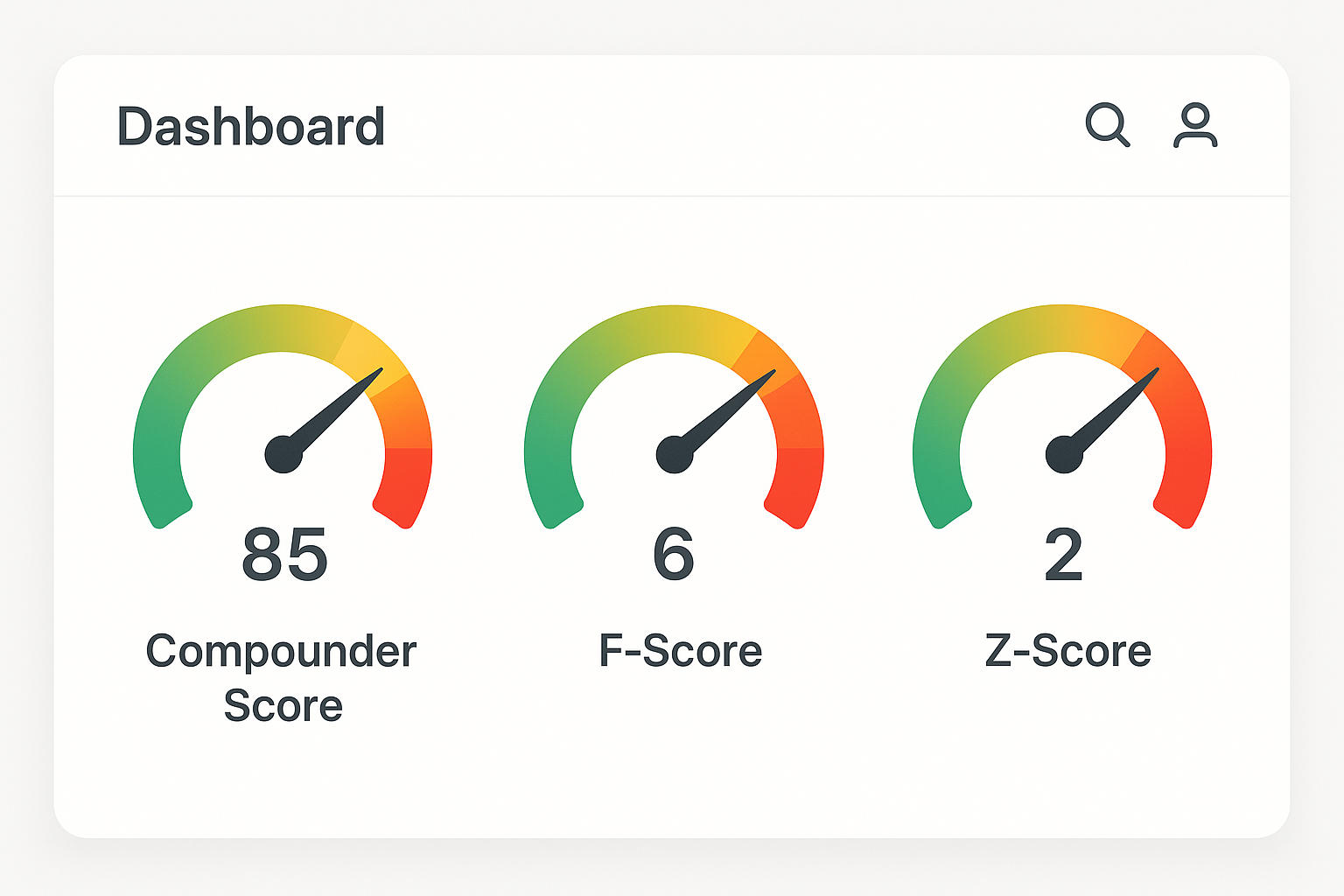
Compounder's Score Comparison page puts three distinct quality scoring systems side by side, so you're not stuck reconciling them in a spreadsheet or across five browser tabs.
Each score answers a different question:
- Compounder Score asks: Is this a quality compounder at a fair price? It blends profitability, capital structure, and valuation into a single view of whether a business is both good and reasonably priced.
- F-Score asks: Are fundamentals improving year-over-year? It's a trend-focused check on whether the underlying business is getting healthier or weaker.
- Z-Score asks: How likely is bankruptcy in the next two years? It's a stress test on capital structure and solvency — the guardrail that catches balance-sheet risk the other scores might not weight as heavily.
A TL;DR section on the page spells out what each score is really asking, so you don't have to reverse-engineer the methodology to know when to use which one. Below that, a detailed, mobile-friendly comparison table lays the three scores out side by side for any company you're researching, so you can see at a glance where a stock is strong, where it's shaky, and whether those signals agree or contradict each other.
Putting It Into Practice
The next time you're evaluating a stock, resist the urge to anchor on a single number. Ask the five questions:
- Is it genuinely profitable?
- Is it financed conservatively?
- Are its earnings real and consistent?
- Does it generate cash, not just accounting profit?
- Are its fundamentals trending up or down?
Then check whether the composite scores agree. A stock that scores well on Compounder Score, shows improving fundamentals on F-Score, and carries a low bankruptcy risk on Z-Score has cleared a much higher bar than one that simply has a low P/E or a catchy growth story.
Quality investing isn't about finding a perfect company — it's about knowing which trade-offs you're willing to accept, and having the data to make that decision with your eyes open.