
Sector Rotation Explained: How to Spot the Shift Before It's Obvious
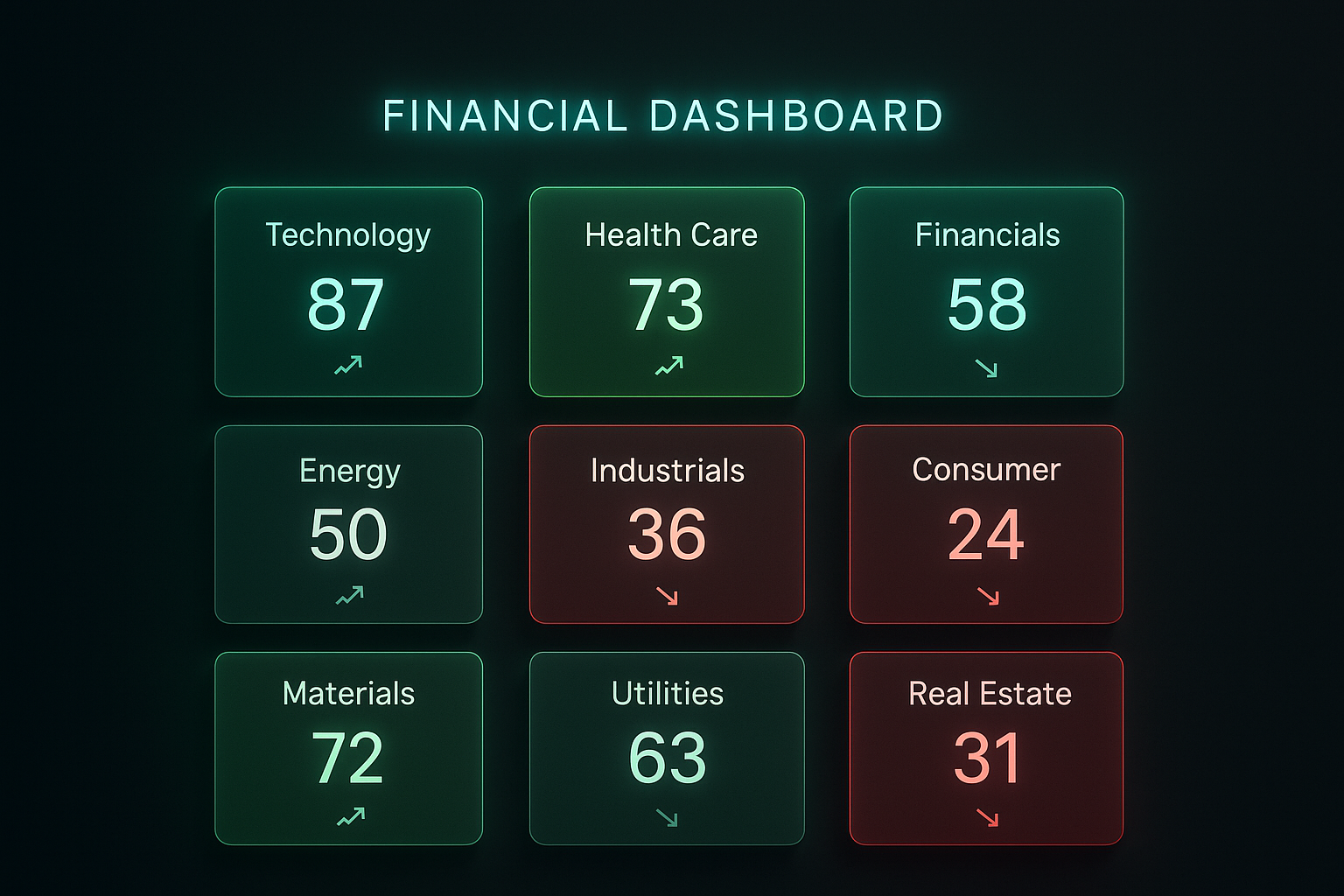
Every market cycle has a rhythm. Money flows into certain sectors when the economy is accelerating, then quietly slides toward defensive names as growth cools. By the time financial news anchors are talking about it, the move is usually half over. If you want to catch sector rotation early instead of reading about it after the fact, you need to watch the underlying data, not the narrative.
Here's what actually drives sector rotation, why it's so hard to catch in real time, and how a data-driven approach can help you see it forming before it's obvious.
What Is Sector Rotation, Really?
Sector rotation is the tendency of capital to move between industry groups as the economic cycle changes. Investors don't hold the same conviction in every sector at every point in time — when growth is accelerating, money tends to chase cyclical, growth-oriented sectors like technology and consumer discretionary. When growth slows or uncertainty rises, capital tends to retreat toward defensive sectors like utilities, healthcare, and consumer staples.
This isn't a fixed formula, and no two cycles play out identically. But the underlying logic is consistent: investors reprice risk and growth expectations sector by sector, well before those expectations show up in a GDP report or an earnings season.
The Cycle: Which Sectors Tend to Lead, Which Tend to Lag
While timing varies, a few patterns show up again and again:
- Early cycle: Financials and consumer discretionary often strengthen first, as easier credit and improving consumer sentiment take hold.
- Mid cycle: Technology and industrials frequently take the lead as business investment and productivity gains accelerate.
- Late cycle: Energy and materials can outperform as inflation pressures build and demand strains supply.
- Downturn / defensive phase: Utilities, healthcare, and consumer staples tend to hold up better as investors prioritize stability over growth.
The key word here is tend. Rotation is a tendency, not a schedule — which is exactly why it's so easy to miss in the moment.
Why Rotation Is Hard to Spot in Real Time
Sector rotation rarely announces itself. It shows up first in relative strength and improving fundamentals within a sector, long before it becomes a headline trend. By the time a sector rotation story is being written up, the early move has often already happened, and the easiest gains are gone.
Most individual investors are stuck watching this unfold through index-level price charts or scattered news coverage, both of which lag the underlying shift in fundamentals. What you really want to track is quality — are the companies within a sector actually improving their profitability, balance sheets, and competitive position, or is a rally being driven by sentiment alone?
A Better Signal: Quality Scores Across Sectors
Instead of watching price action after the fact, it's far more useful to track how the quality of companies within a sector is trending. When you look at quality scores side by side across sectors — who's improving, who's holding steady, who's deteriorating — you start to see rotation forming before it shows up in headlines.
Think of it as scanning for where strength is quietly building and where it's quietly fading. A sector where a growing share of its top names are improving in profitability and financial health is a sector gaining underlying support, even if the price action hasn't caught up yet. A sector where quality scores are slipping across the board is often flashing an early warning, regardless of how the sector's index chart looks that week.
This is the kind of signal that's easy to describe but hard to track manually — you'd need to pull financials on dozens of companies across multiple sectors and refresh that analysis constantly. That's exactly the gap Compounder is built to close.
Catching the Shift Before It's Obvious
Ask the AI Analyst
Rather than digging through spreadsheets, you can go to AI Analyst in the main navigation and ask directly. Type a question — something like which sectors are showing the most quality improvement this quarter, or how a specific sector's fundamentals compare to last year — and press Cmd/Ctrl + Enter (or just Enter in the bottom input) to send it. If you're not sure where to start, the suggested question pills on first visit give you a running start. Once you send a message, the view shifts into a scrolling conversation, so you can keep asking follow-up questions and build out a clearer picture of where strength is building sector by sector.
Set Alerts That Do the Watching for You
You don't have to check in manually every day to catch a rotation forming. In the Alerts section, you can create custom alerts that flag changes automatically:
- Score Regime Change — fires when a stock's quality tier shifts, which is often the earliest sign that a name (and by extension, its sector) is strengthening or weakening.
- Quality Streak Break — fires when a stock's profitability streak ends, a useful early warning that fundamentals are turning.
- Fat Pitch — fires when a watchlist stock combines high quality with attractive valuation, which is exactly the setup you want to catch as a sector starts to strengthen.
- Legend 13F — fires when tracked investment legends file new holdings, giving you a read on where sophisticated capital is positioning.
Stack a few of these across a basket of stocks that represent different sectors, and you effectively build a rotation early-warning system — one that's watching the data continuously instead of waiting for you to notice a chart pattern.
Building a Rotation Watchlist
A simple way to put this into practice: build a watchlist with a handful of representative names from each major sector, then layer Score Regime Change and Quality Streak Break alerts on top. When alerts start clustering in one sector — several names improving in quality tier at once — that's often your earliest, most objective signal that money is beginning to rotate that direction. When you see the opposite pattern, streaks breaking across a sector, treat it as a signal that leadership may be fading, whether the headlines have caught on yet or not.
Sector rotation will keep happening every cycle — that part is constant. What changes is how early you can see it. By watching quality trends instead of waiting for price action or news coverage to confirm the move, you give yourself a real shot at getting there first.