
Special Situations Investing: How to Spot Spin-Offs, IPOs, and Insider Buys Before the Crowd Does
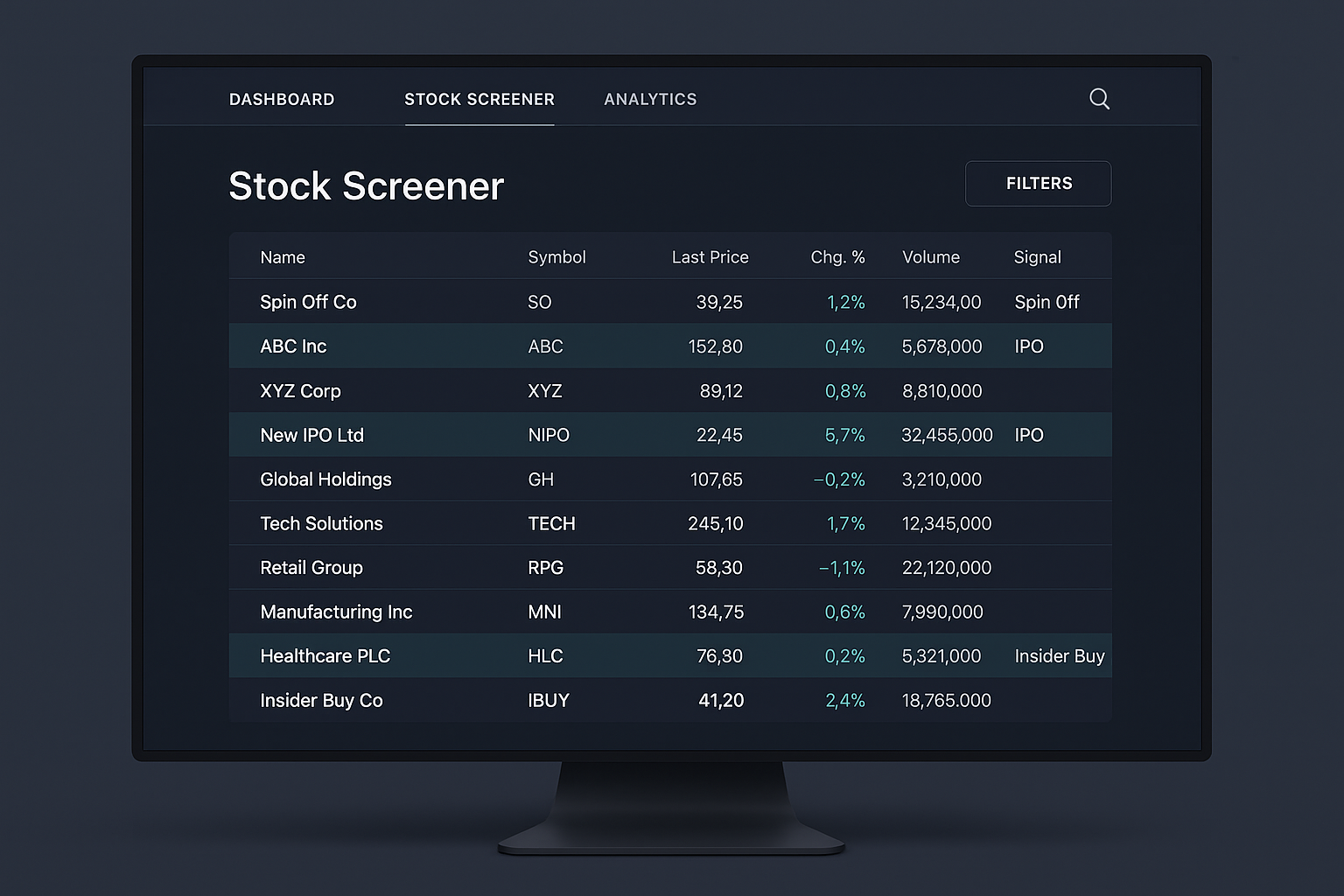
Some of the most attractive opportunities in the stock market don't come from a hot earnings beat or a viral headline. They come from structural quirks — a company being spun off from its parent, a recent IPO still finding its footing, or a cluster of executives quietly buying shares with their own money. This is the world of special situations investing, and it's a corner of the market that institutional investors have exploited for decades. The good news: you don't need a trading floor to do the same. You need to know what to look for and where to look.
What Counts as a Special Situation
Special situations are events that temporarily disconnect a stock's price from its underlying value — not because the business is broken, but because the market hasn't figured out how to price it yet. A few patterns show up again and again.
Spin-Offs
When a company spins off a division into its own publicly traded entity, the new stock often gets dumped by index funds and institutional holders who received shares automatically but have no mandate to hold them. That forced, valuation-agnostic selling can push the price below what the business is actually worth — at least until the market re-rates it once real ownership settles in.
Recent IPOs
Newly listed companies go through a similar adjustment period. Early trading is often driven by hype, lockup expirations, and thin analyst coverage rather than fundamentals. As the noise fades and more information becomes available, prices can move meaningfully in either direction — which is exactly why recent IPOs deserve a closer look, not a wait-and-see shrug.
Cluster Insider Buying
One buy from an executive can mean almost anything — tax planning, compensation timing, diversification needs. But when multiple insiders at the same company buy shares within a short window, using their own money, it's a much stronger signal. People with the best view of a business rarely all decide to bet on it at once unless they believe it's undervalued.
Institutional Accumulation
When sophisticated institutional holders steadily increase their position in a stock, it often reflects conviction built on deeper research than most individual investors have access to. Tracking where that money is flowing can point you toward situations worth a second look.
Why These Signals Matter
Each of these signals on its own is useful. Layered together, they become much more powerful. A recent spin-off with cluster insider buying is a different story than a spin-off with no insider activity at all. A new IPO where institutions are quietly accumulating shares tells you something the stock chart alone never will.
The challenge has always been access and time. Institutional research desks build workflows specifically to catch these setups as they happen. Retail investors, historically, have had to piece the same picture together from scattered filings, press releases, and insider disclosure databases — usually after the opportunity has already been priced in.
How to Read Insider Buying Signals
Insider transaction data is public, but reading it well means knowing what to look at. On a stock's detail page in Compounder, the Insiders tab breaks down every transaction into a clear table:
- Date — when the transaction occurred
- Insider — the officer or director involved
- Position — their title (CEO, CFO, director, and so on)
- Action — Buy, Sell, Award, or Exercise
- Shares — the quantity traded
- Price — the per-share price, when available
- Value — the total dollar amount of the transaction
- Holding — how many shares the insider retains after the trade
This is where the difference between noise and signal becomes visible. A single small Award or Exercise tells you very little — those are often routine compensation events. A cluster of open-market Buy transactions from multiple executives, especially at meaningful dollar values relative to their existing Holding, is a much more interesting pattern worth digging into further.
Finding Special Situations Before the Crowd
Manually cross-referencing spin-off calendars, IPO lists, and insider filings for every stock you're curious about isn't realistic for an individual investor. That's the exact problem the Special Situations screener is built to solve.
Accessible from the Screener section, it searches for undervalued opportunities across three key signals at once — recent listings (IPOs and spin-offs), insider buying, and institutional accumulation. Two filters at the top control how the screen runs:
- Recent-listing window — choose how far back to look for IPOs or spin-offs: 90 days, 180 days, 1 year, 2 years, or 3 years
- Minimum signals required — decide whether a stock needs to show 1, 2, or all 3 signals to appear in your results
Setting the minimum to "all 3" narrows your results to stocks that are recently listed, seeing insider buying, and attracting institutional accumulation simultaneously — the kind of convergence that's rare enough to be worth investigating every time it shows up. Setting it to "1" casts a wider net for early-stage ideas you can monitor as more signals develop.
Building a Repeatable Process
Special situations investing rewards a process, not a one-off search. A simple routine looks like this:
- Run the Special Situations screener on a regular cadence — weekly is usually enough to catch new spin-offs and IPOs entering their window.
- For any stock that surfaces, open the Insiders tab and look past single transactions to patterns — clusters of Buy actions across multiple executives, or steady accumulation over several months.
- Cross-check the position and holding size of the insiders involved. A director buying a small stake reads differently than a CEO meaningfully increasing their ownership.
- Widen or narrow the recent-listing window depending on whether you're hunting for fresh IPOs or giving spin-offs more time to shake out forced sellers.
None of this requires predicting the market or timing a catalyst perfectly. It requires paying attention to structural mispricings that already exist and having a systematic way to find them before they're common knowledge. That's the entire premise of special situations investing — and increasingly, it's a strategy individual investors can run just as rigorously as the institutions that popularized it.